
The situation
Entertainment is one of the most unpredictable niches in search engine optimisation. Unlike evergreen industries, entertainment websites frequently depend on trending topics, breaking updates and rapidly changing search demand. An article can attract thousands of visitors within a short period, but its traffic can decline just as quickly when the topic loses popularity.
When I started on 23 May 2026, the website was already receiving approximately 50K–60K organic visitors a day, around 1.8 million a month. The opportunity: it needed more than a continuous stream of trending articles. It needed a content strategy that could capture immediate search demand while gradually building a sustainable evergreen library, without completely restructuring the existing website architecture.
As SEO strategy and campaign lead at Zuptek Infotech, I took responsibility for the complete SEO strategy, campaign planning and overall direction. Before implementing anything, I identified five challenges:
- Heavy dependence on trending topics. Trending articles could generate substantial traffic, but their performance was often temporary.
- Keyword cannibalisation. Publishing at scale created overlapping search intent, with articles competing for the same visibility.
- Crawl management. Thousands of URLs plus daily publishing put pressure on crawling, discoverability, sitemap accuracy and internal linking.
- Inefficient internal linking. Unnecessary anchors, irrelevant recommendations and clickbait-style links made for a poor browsing experience.
- Content production at scale. Keeping up the publishing frequency while controlling overlap, relevance and editorial quality needed a coordinated workflow.
What we did
One central principle guided the work: give users what they want, where they want it, and make their next discovery easier. Instead of concentrating only on rankings and publishing volume, I focused on the relationship between content, search intent, technical discoverability and user experience.
- Trending + evergreen content model. The most important strategic decision. For every six articles, about five covered trending demand and one targeted recurring, evergreen search interest, so the library keeps earning after individual trends fade. It balanced trending content rather than replacing it. See the service page
- User journey optimisation. An SEO strategy should not end at the click. I rebuilt internal linking from the reader's perspective: meaningful contextual links, more relevant anchor text, clickbait-style anchors removed, better related-article recommendations, and navigation paths tied to the reader's next likely action. The goal was a useful destination, not a collection of landing pages. See the guide
- Content production at scale. A daily workflow of about five to six articles, trending and evergreen, using AI-assisted drafting with human editorial work for relevance, context and quality: intent alignment, topic selection, differentiation and avoiding overlap. About 3,000 pages and articles were published or optimised.
- Keyword cannibalisation management. Overlapping articles were identified and differentiated so each page had a clearer purpose within the content ecosystem. See the guide
- Technical SEO and crawl management. Broken links in the XML sitemaps fixed, crawl and discoverability managed for a frequently updated site, contextual internal links improved, and ongoing implementation run with the development team, all on the existing architecture. See the service page
- Off-page SEO and link building. Niche-relevant link placements, niche edits, digital PR, relevant external mentions and outreach, executed by junior team members under the overall strategy. See the guide
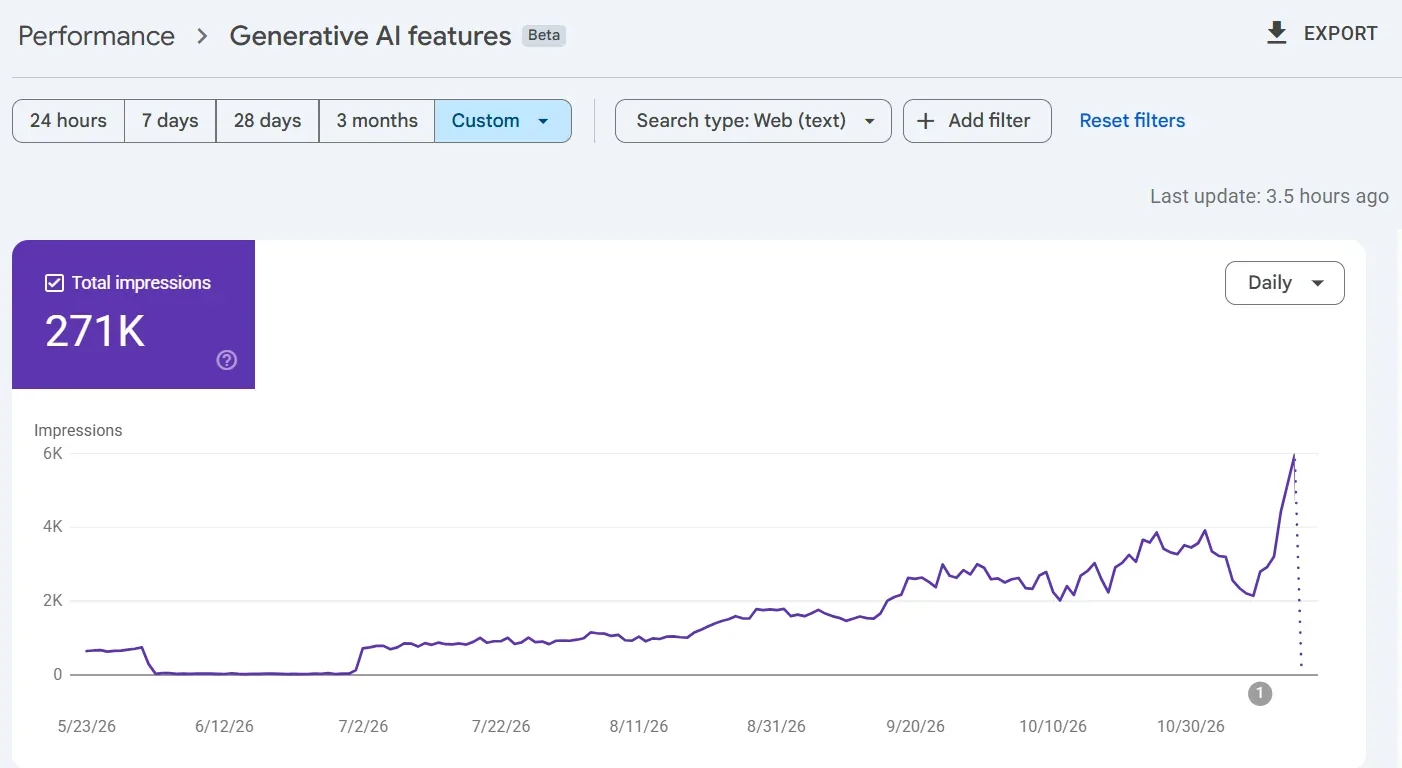
- AEO and GEO. Relevant forum discussions already surfaced or cited in generative AI experiences were identified, and relevant mentions earned within them. Google Search Console's Generative AI features report was monitored throughout. See the service page
Outcome
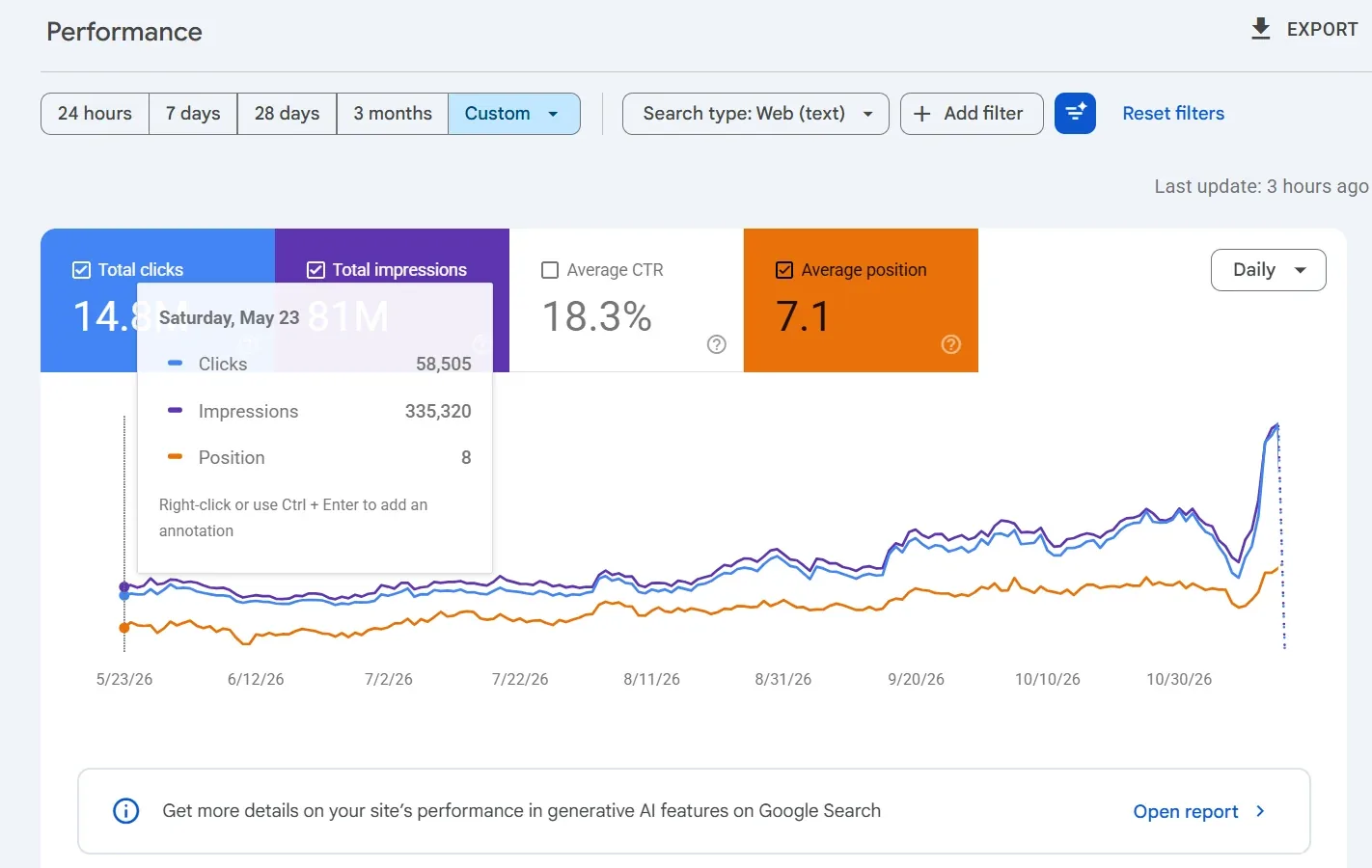
Between 23 May and 14 November 2026, the website recorded 14.8 million Google clicks and 81 million impressions, at an 18.3% average CTR and an average position of 7.1. Figures are from Google Search Console unless stated.
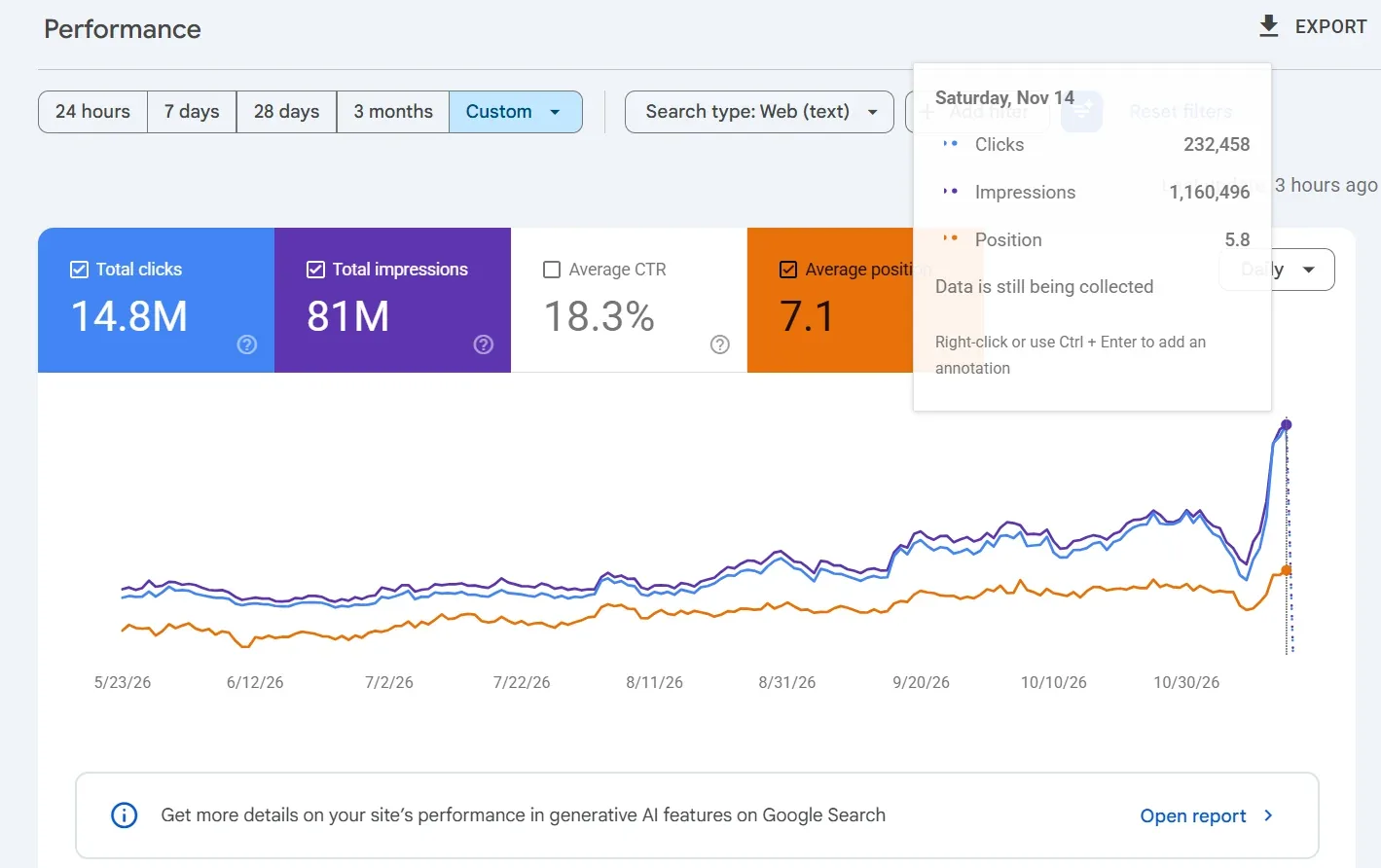
The clearest milestone was crossing 200K daily clicks. On 14 November the site recorded 232,458 clicks, against 58,505 on 23 May: about 3.97 times the starting day. Both are single-day observations, not averages.
| Search Console | Full campaign 23 May – 14 Nov | Last three months | 14 Nov 2026 single day |
|---|---|---|---|
| Clicks | 14.8 million | 9.62 million | 232,458 |
| Impressions | 81 million | 52 million | 1,160,496 |
| Average CTR | 18.3% | 18.5% | – |
| Average position | 7.1 | 6.8 | 5.8 |
Visibility in AI search grew alongside. The Generative AI features report recorded approximately 271K impressions over the campaign, climbing from under 1K a day in July to about 6K a day by mid-November.
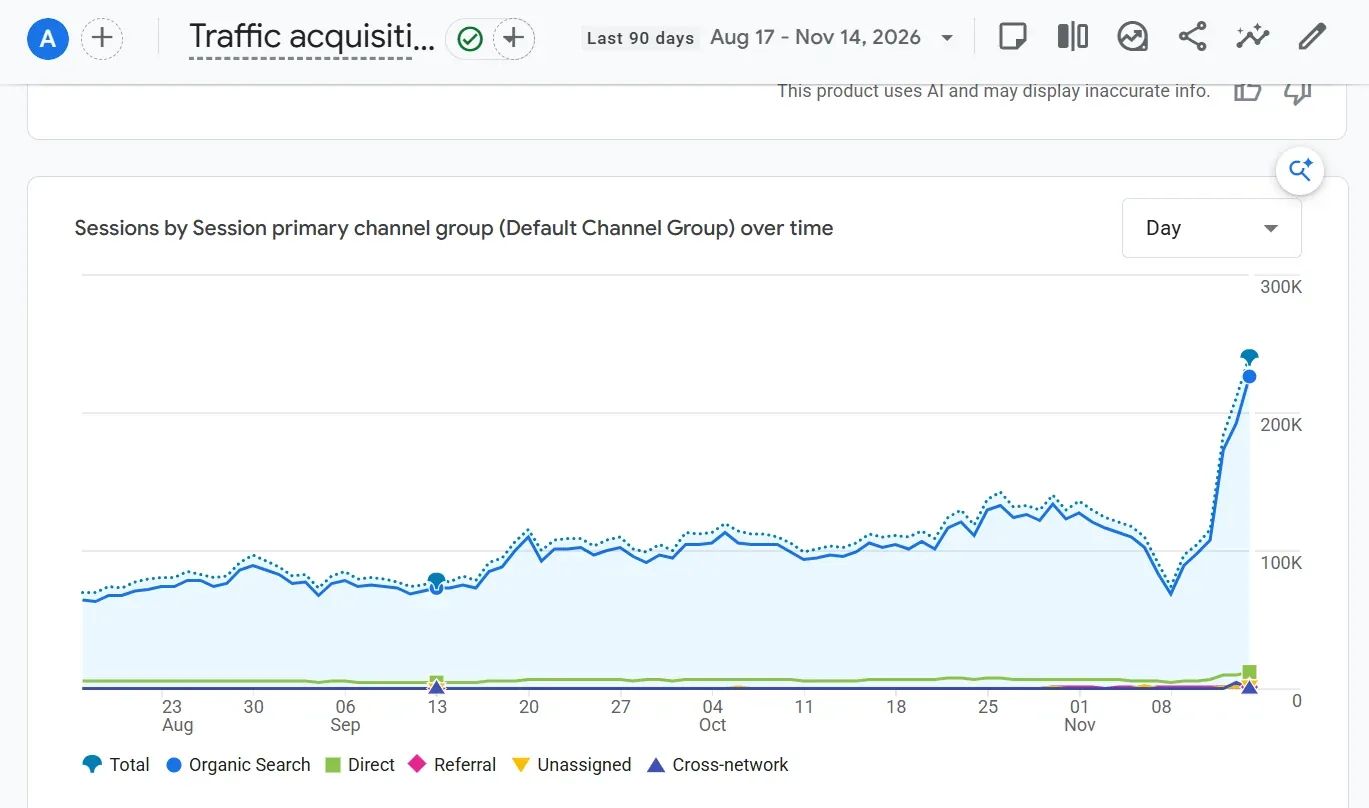
Organic Search was the dominant acquisition channel in Google Analytics 4, with daily organic activity trending upward and rising sharply towards the end of the period.
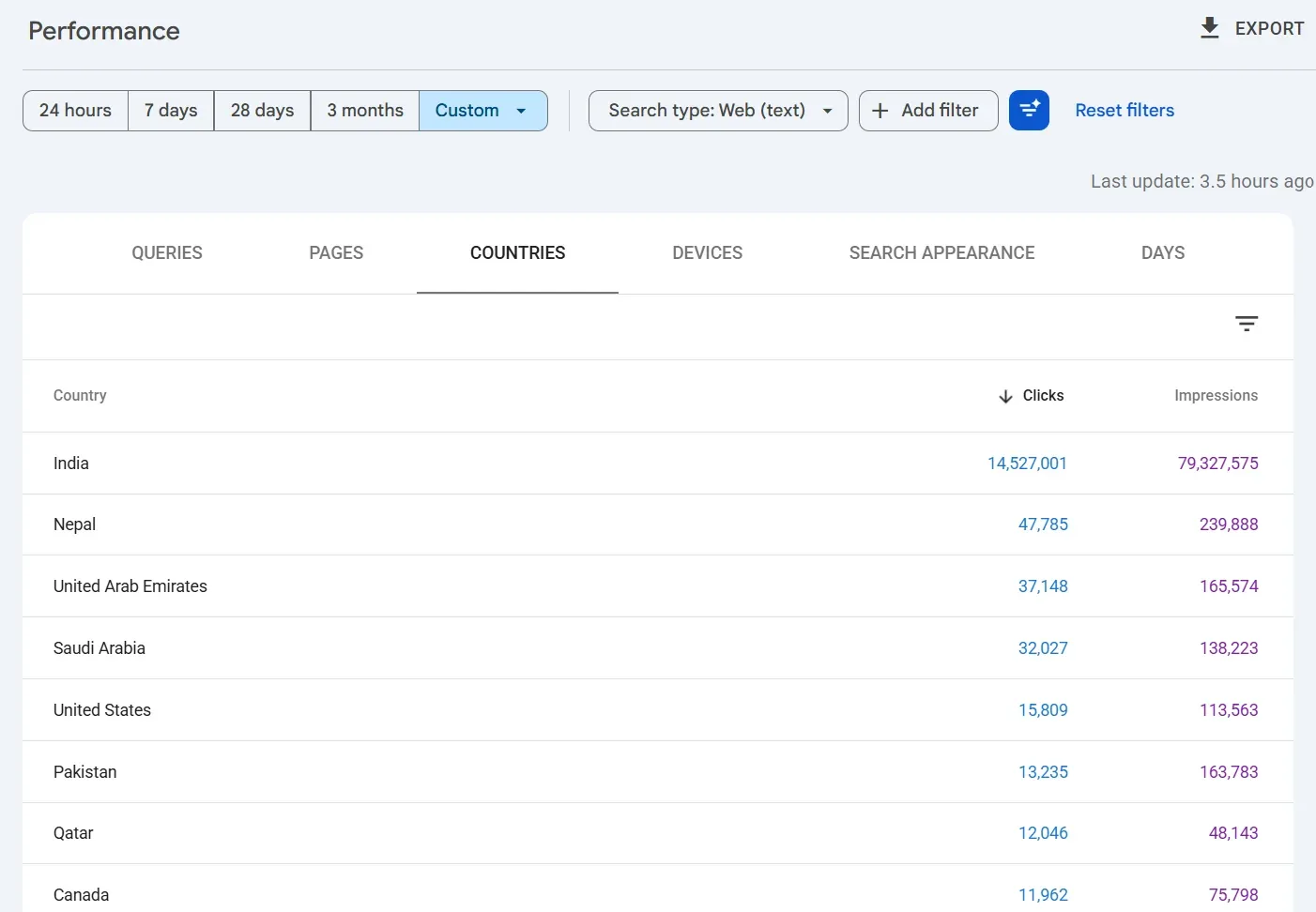
India was the primary market, but content was also discovered across several international markets.
| Country | Clicks | Impressions |
|---|---|---|
| India | 14,527,001 | 79,327,575 |
| Nepal | 47,785 | 239,888 |
| United Arab Emirates | 37,148 | 165,574 |
| Saudi Arabia | 32,027 | 138,223 |
| United States | 15,809 | 113,563 |
| Pakistan | 13,235 | 163,783 |
| Qatar | 12,046 | 48,143 |
| Canada | 11,962 | 75,798 |
The CMS showed the scale of publishing: 2,995 posts in total, 2,976 published, 17 drafts, 1 scheduled and 1 pending.

The team
A project with thousands of pages, daily publishing and ongoing technical work cannot be run by one person. I led the strategy and campaign direction and made sure content, technical implementation and off-page work pulled towards the same objectives.
| Role | Responsibility |
|---|---|
| SEO strategy and campaign lead (me) | Overall SEO strategy, planning and campaign leadership |
| SEO specialist | SEO implementation and optimisation |
| Development expert | Technical implementation and website support |
| Lead writer | Editorial planning and content production |
| Junior outreach team | Link-building outreach and execution |
What I learned
- Trending content needs an evergreen foundation. Trends are valuable, but they should not be the only source of organic opportunity.
- Publishing volume needs strategic control. More articles do not automatically mean better performance; overlap, cannibalisation and crawl management matter more as a site grows.
- Internal linking should serve readers. Links should lead to genuinely relevant information; more links without intent do not improve the experience.
- User satisfaction is a strategic priority. Deliver what visitors expect after the click, and give them reasons to explore further and return.
- Large-scale SEO requires collaboration. Technical SEO, development, editorial production and outreach have to work as one operation.
My SEO philosophy is simple: give users what they want, make it easy for them to find it, and give them a reason to trust your website the next time they search.