
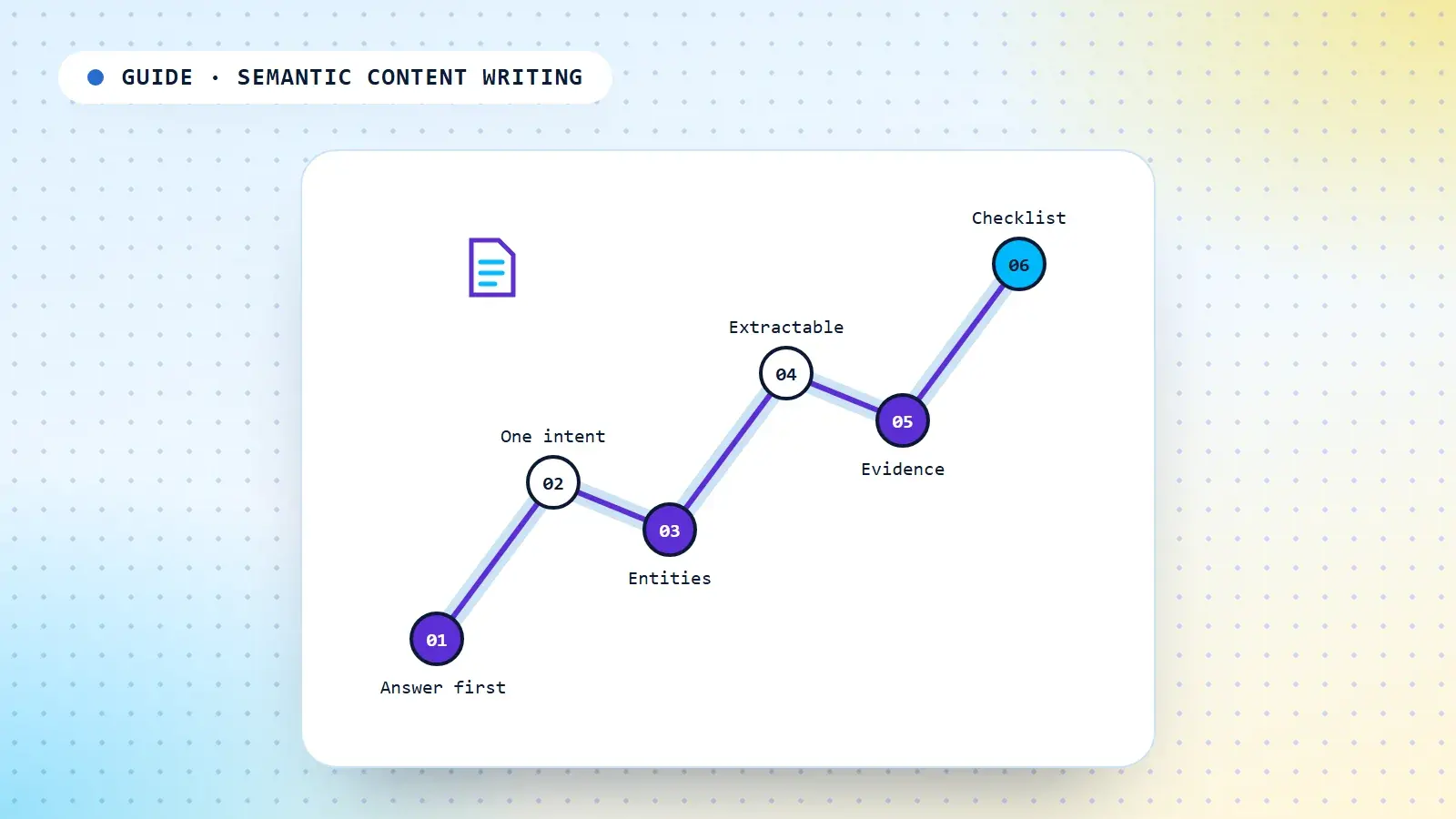
Most of what decides whether a page is understood happens at the level of the sentence and the paragraph. Strategy picks the topic, the brief fixes the intent and the outline, and then a writer either produces text whose meaning a search engine or an AI system can recover with confidence, or text that says a lot without stating much.
Semantic content writing is the craft of writing so that the subject, the facts about it and the relationships between them are explicit on the page. It is the writing-level half of semantic SEO. This guide sets out the rules I use when I write and edit, with an example rewrite and the checklist I run before anything goes live. It assumes the planning has been done: deciding which pages exist belongs to content SEO, and deciding what each page must contain belongs to the content brief. Here the question is narrower: given a good brief, how do you write the page?
What semantic content writing means in practice
Search engines and language models read a page by working out which things it talks about, what it says about each of them, and how confident they can be that a given passage answers a given question. They do this from the text. They do not know what you meant to say; they only see what you wrote. Every vague pronoun, every unexplained term and every claim with no number behind it is a small loss of meaning.
So the rules below are not tricks. Each one removes a specific kind of ambiguity. Taken together they produce pages that a reader finds quick to use, that a ranking system can classify correctly, and that an answer engine can quote without misrepresenting you. Those three outcomes come from the same habits.
Rule 1: answer the main question early and directly
The first two or three sentences under the H1 should answer the question the page exists for, in plain words, before any context, history or scene-setting. If the page is "how long does a passport renewal take", the opening states the typical range and what changes it. If the page is a definition, the opening is the definition. Background comes after the answer, for readers who want it.
This matters for three reasons. A reader who arrives from search decides within seconds whether the page is for them. A search engine weighs the opening heavily when deciding what the page is about. And an answer engine looking for a quotable passage will usually find it near the top, if one exists. A page that opens with "In today's fast-paced digital world" fails all three.
The same rule applies inside each section. Lead with the claim, then support it.
Rule 2: one main intent per page
A page should satisfy one dominant search intent. It can answer secondary questions that the same searcher has, but it should not try to be a definition, a buying guide and a troubleshooting page at once. When a page mixes intents, its subject blurs: the opening cannot answer everything, the headings pull in different directions, and the page tends to rank weakly for all of them.
The test I use is to write one sentence that begins "A reader lands here because they want to…". If I need "and" twice to finish it, the page probably needs splitting. The second intent usually deserves its own page, linked from this one. Which pages exist is a keyword mapping decision, but writers are often the first to notice that a draft is serving two masters, and they should say so.
Rule 3: headings that mirror the reader's questions
Headings are the page's table of contents for readers and its outline for machines. A good H2 tells you what the section answers. "Pricing" is a label; "How much does a home solar system cost in India?" or "What decides the cost" is a question the section will resolve. Not every heading needs to be a question, but each should let a reader guess the section's main point.
Keep the hierarchy honest. H2s are the main questions; H3s are sub-questions or parts of the H2 above them, never a new topic. Do not skip levels for visual effect, and do not use heading tags to style text. When I read only the headings of a finished page, top to bottom, they should read like a sensible sequence of questions the reader would ask. If they read like a list of keywords, the page was written for a crawler that no longer exists.
Rule 4: define entities and their attributes explicitly
An entity is a distinct thing: a product, a person, an organisation, a place, a concept, a regulation. Every page has a main entity and several supporting ones. Semantic writing names them clearly, defines each one the first time it matters, and states its attributes as facts rather than leaving them implied.
Compare "It is a great option for people who travel a lot" with "A forex card is a prepaid card loaded with one or more foreign currencies, used to pay abroad at a locked exchange rate." The second sentence names the entity, places it in a category (a prepaid card) and gives two attributes (multi-currency, locked rate). A reader learns something. A machine can extract a clean subject, type and properties. The first sentence gives neither of them anything to hold.
Practical habits that help:
- Define on first use. The first time a term appears, say what it is in a short clause. Do not assume the reader or the system shares your vocabulary.
- Name the category. "X is a type of Y" is one of the most useful sentence shapes in semantic writing, because it places the entity in a known group.
- Prefer nouns to pronouns across paragraph breaks. "It" at the start of a new paragraph is ambiguous once that paragraph is quoted on its own.
- State relationships. "UPI runs on infrastructure operated by NPCI" tells the reader how two entities connect; listing both names in the same paragraph does not.
The entity SEO guide covers how search engines identify entities and how sites establish their own; this rule is simply the writing habit that supports it.
Rule 5: keep terminology consistent
Writers are taught to vary their words to avoid repetition. In semantic writing, that instinct needs managing. If a page calls the same thing a "plan", a "policy", a "cover" and a "product" in four consecutive paragraphs, a careful reader wonders whether these are four different things, and a machine has to guess. Pick one primary term for each entity, introduce any common alternative once ("term insurance, sometimes called term life cover"), and then stay with the primary term.
The same applies across a site. If one guide says "keyword mapping" and its sibling says "keyword-to-URL assignment" for the same process, internal links and topic signals become muddier than they need to be. For larger sites I keep a short terminology list alongside the style guide, and a glossary helps both readers and writers settle on shared definitions.
Rule 6: specific facts over vague claims
Vague claims are the clearest marker of generic content. "Many businesses", "significantly faster", "affordable pricing" and "industry-leading" carry almost no information. A specific statement can be checked, quoted and trusted. Where you have the fact, use it. Where you do not, either find it from a primary source or remove the claim. Do not invent precision you do not have.
| Vague version | Specific version | What changed |
|---|---|---|
| The process is quick and easy. | Registration takes one form and an OTP to the mobile number linked to your Aadhaar. | Names the steps and what the reader needs ready |
| Prices vary depending on many factors. | Price depends mainly on capacity, panel type and whether you choose an on-grid or hybrid system. | Names the factors, in order of influence |
| It works for most businesses. | It suits retailers with a single GSTIN and fewer than a few hundred SKUs; multi-warehouse inventory needs a different tool. | States who it is for and who it is not for |
| Our team has years of experience. | I have run this audit on ecommerce, SaaS and local business sites since 2016. | Replaces an adjective with a verifiable statement |
Two cautions. First, figures that change, such as tax thresholds, fees, limits and prices, need a date or a "check the current figure" pointer, because a confident wrong number is worse than none. Second, specificity also means stating limits. "This does not apply if…" is one of the most trust-building sentences a page can contain.
Rule 7: write passages that stand on their own
Search engines can rank individual passages, and AI answer systems assemble responses from fragments of pages. A fragment is only useful if it makes sense without the paragraphs around it. That changes how you build each block of text.
Self-contained paragraphs
Each paragraph that answers something names its subject, makes one point and finishes it. Avoid "as mentioned above" and "this" referring to a previous section.
Definition sentences
One sentence that says what the thing is, its category and its defining attribute. Put it directly under the heading it answers.
Lists for sets and sequences
Use a numbered list when order matters and a bulleted list when it does not. Start each item with the key word, not a preamble.
Tables for comparisons
When the reader compares several things on the same attributes, a table states every value explicitly. Prose comparisons hide them.
I explain why extraction matters for ranking and for AI answers in the AI SEO guide. The writing consequence is simple: every section should contain at least one passage that someone could lift out, quote and still be accurate.
Rule 8: cover the expected attributes in a sensible order
For any entity, readers expect certain attributes to be covered. A page about a medicine is expected to address use, dosage, side effects and interactions. A page about a city neighbourhood is expected to cover location, connectivity, housing costs, schools and safety. If a page skips an attribute readers consider essential, it feels incomplete, and the reader goes back to search for the missing piece.
The brief usually lists the entities and sections; the writer's job is ordering. My default is to follow the reader's decision path: what it is, whether it applies to me, how it works, what it costs or requires, what can go wrong, and what to do next. Defining attributes come before comparative ones, and common cases come before edge cases.
Rule 9: contextual internal links with descriptive anchors
An internal link inside a sentence tells the reader and the search engine that two pages are related and how. The anchor text is part of that statement. "Read more about topical authority" carries meaning; "click here" carries none. Link where the related concept is actually mentioned, use anchor text that describes the destination page's subject, and vary it naturally rather than repeating one exact phrase across the site.
Every page should link to its hub early, to sibling pages where it references their subjects, and outwards to a deeper page wherever it deliberately stops short of covering something. The mechanics of choosing targets and anchors are in the internal linking guide; at the writing stage, the discipline is to place links where a reader would want them, not in a block at the bottom.
Rule 10: show evidence and first-hand experience
Pages that can only repeat what other pages say add nothing to the index. What makes a page worth ranking is often something only its author has: a result from their own testing, a photograph of the actual product, a mistake they made and how they fixed it, a judgement call explained.
In writing, this means stating where knowledge comes from. "In audits I have run, the most common cause is…" is different from "The most common cause is…". Cite primary sources such as official documentation, regulators and standards bodies, not other blogs on the same query. Mark opinions as opinions. And never manufacture experience: if a draft says "we tested" and nobody did, delete the sentence.
Rule 11: cut filler and keyword stuffing
Filler is any sentence that could be removed without the reader losing information. The common types are throat-clearing introductions, restating the heading as a sentence, generic statements of importance ("SEO is crucial for every business"), summaries of what you are about to say, and conclusions that repeat what you just said.
Keyword stuffing is the older relative: repeating a target phrase, or awkward variants of it, because someone believed frequency was the signal. Modern systems model meaning, so repetition does not help and often reads as manipulation. Use the primary term where it naturally belongs, in the title, the H1 and the opening, and then write about the subject as a person would. If a sentence only exists to contain a phrase, it is filler too.
My editing test is blunt: delete a sentence and reread the paragraph. If nothing is lost, it stays deleted.
Writing for Hindi, Hinglish and regional audiences
A large share of Indian searchers read and search in Hindi or another Indian language, or in Hinglish typed in Roman script. If your audience searches that way, the same semantic rules apply, with a few additions specific to language choice.
- Match the language and script people actually search in. Look at real queries in Search Console and at the SERP itself. Hinglish queries such as "home loan kaise le" are usually typed in Roman script, while other audiences search in Devanagari. The page should use the form its readers use.
- Keep the terms people really say. Many readers say "EMI", "GST" or "loan" in English even within Hindi sentences. Replacing them with formal Hindi equivalents can make a page technically correct and practically unfamiliar. Define a term in both forms once if both are common, then stay consistent.
- Do not publish machine translations unedited. Literal translation produces stiff phrasing, wrong register and occasionally wrong meaning. A fluent editor should review every translated page against the original for accuracy, not just grammar.
- One language per page. Mixing full English paragraphs with full Hindi paragraphs on the same URL confuses both readers and language detection. Separate language versions belong on separate URLs, connected with hreflang, as the international SEO guide explains.
- Do not stuff spelling variants. Romanised Hindi has many spellings of the same word. Search engines generally connect common variants; listing several versions on the page only makes it harder to read.
- Use local examples. A page for readers in Lucknow or Indore should use prices in rupees, local institutions and situations those readers recognise.
How to edit AI-assisted drafts
AI writing tools produce fluent text quickly, and fluent is not the same as specific, accurate or useful. How to brief a model properly is covered in the content briefs guide. This is what I do once a draft exists. I treat an AI draft as raw material from a fast junior writer who has never met the reader and cannot verify anything.
Check the intent and the opening
Read the first three sentences. Do they answer the page's main question directly? Models tend to open with context and importance statements. Rewrite the opening until it answers first.
Verify every factual claim
Mark every number, date, name, rule, product feature and quotation. Check each against a primary source. Anything you cannot verify is removed, not softened. Models produce plausible figures and citations that do not exist.
Replace generic statements with specific ones
Search for words like "various", "numerous", "crucial", "seamless" and "in today's world". Each one usually marks a sentence that needs a fact or needs deleting.
Fix terminology and entity naming
AI drafts drift between synonyms. Pick the primary term for each entity and make the draft consistent. Check that every term is defined on first use.
Add what only you know
Insert first-hand experience, real examples, your own judgement and the trade-offs you have seen. This is the part that makes the page worth publishing, and no model can supply it for you.
Restructure for extraction
Turn buried comparisons into tables and buried sequences into numbered lists. Make sure each section has a self-contained passage that answers its heading.
Cut, then read aloud
Remove repetition, summaries of summaries and closing paragraphs that restate the page. Then read it aloud. Text that sounds like no particular person wrote it still needs work.
A before-and-after rewrite
Here is a typical opening paragraph from a page targeting "water purifier for borewell water", followed by my rewrite.
Before:
Choosing the right water purifier is very important for the health of your family. There are many types of water purifiers available in the market today, and each comes with its own benefits. Water purifier technology has advanced a lot, so it is essential to choose the best water purifier for borewell water that suits your needs. Read on to know more.
After:
For borewell water, start with a TDS (total dissolved solids) test, because the reading decides which purifier you need. Reverse osmosis (RO) is the common home technology that substantially reduces dissolved salts; UV and UF purifiers treat microbes and particles but leave TDS largely unchanged. Borewell water with high TDS therefore needs RO, usually combined with UV. A handheld TDS meter gives a reading in seconds; compare it with the limits in BIS's drinking water standard, IS 10500, before you buy.
What changed:
- The first sentence now answers the query and tells the reader what to do first.
- Entities are named and defined: TDS, RO, UV, UF, BIS and IS 10500, each with its role stated.
- Relationships are explicit: which technology affects which property of the water, and why that leads to a recommendation.
- The vague claims ("very important", "advanced a lot", "its own benefits") are gone, along with the keyword repeated three times and the "read on" filler.
- The paragraph stands on its own. Quoted in an AI answer, it would still be accurate and useful.
The rewrite is about the same length as the original. Semantic writing is not about writing more; it is about making every sentence carry information.
Pre-publish checklist
I run this on every page after the brief review, which checks scope and coverage. This one checks the writing itself.
- Answer first: the opening two or three sentences answer the main question without preamble.
- One intent: the page serves one dominant intent; secondary intents are linked out, not crammed in.
- Headings: read alone, the H2s and H3s form a logical sequence of reader questions, with no skipped levels.
- Entities: the main entity is named in the title, H1 and opening; every key term is defined on first use.
- Terminology: one primary term per entity, used consistently; alternatives introduced once.
- Specificity: no unsupported "many", "significant" or "best"; changeable figures carry a date or a source.
- Extractability: each section has a self-contained passage; comparisons are tables, sequences are numbered lists.
- Attributes: every attribute a reader would expect is covered, in decision order.
- Links: hub linked early, siblings linked where mentioned, anchors describe the destination.
- Evidence: claims trace to primary sources; first-hand experience is real and labelled as such.
- No filler: every sentence survives the delete test; the primary term is not repeated for its own sake.
- Language: the language and script match how the audience searches; translations were reviewed by a fluent editor.
None of these rules is new; the effect comes from applying all of them to every page. A site where every page states its subject clearly, defines what it discusses and backs what it claims is a site that search engines and AI systems can understand, and that readers come back to. The SEO content framework shows how this writing standard fits into a full content process.
Frequently asked questions
What is semantic content writing?
Semantic content writing is writing so that a page's subject, the facts about it and the relationships between things are stated explicitly. It means answering the main question early, defining entities, using consistent terms and writing self-contained passages. The result is a page that readers, search engines and AI answer systems can all understand without guessing what you meant.
How is semantic content writing different from semantic SEO?
Semantic SEO is the wider practice of making a site's meaning clear through topic coverage, site structure, internal links and structured data. Semantic content writing is the part that happens in the text itself: how sentences, paragraphs and headings state the subject and its attributes. You need both, but writing is where most pages lose clarity.
Does semantic writing mean using lots of related keywords?
No. Sprinkling related keywords or synonyms is a leftover from string matching. Semantic writing covers the entities and attributes a complete answer needs, names them clearly and explains how they relate. Related terms appear naturally when you do that. Forcing in variants usually makes the text harder to read and adds nothing a modern system rewards.
How do I make content easier for AI answer engines to cite?
Write passages that make sense on their own. Put a direct answer under each heading, define terms in one clear sentence, use numbered lists for steps and tables for comparisons, and avoid references like 'as mentioned above'. Back claims with primary sources. A passage that stays accurate when quoted out of context is the kind AI systems can use.
Can I use AI tools to write semantic content?
You can use them to produce a first draft from a proper brief and supplied sources. The draft then needs a human edit: verify every fact, rewrite the opening to answer first, fix inconsistent terminology, add first-hand experience and cut generic sentences. The publisher stays responsible for every claim, however the first draft was produced.
Should I write Hinglish content for Indian audiences?
Only if your audience actually searches that way. Check Search Console queries and the SERP: some audiences type Hinglish in Roman script, others search in Devanagari or English. Match what they use, keep everyday English terms like EMI or GST where readers use them, keep one language per page and have a fluent editor review anything translated.