
Search "Mercury" and a search engine has to decide whether you mean the planet, the element, the Roman god or a band's late singer. Search your own business name and it has to make the same decision about you. If the name is common, the facts about you are scattered, or different websites disagree on who you are and what you do, the engine's best guess may be wrong, vague or missing. Entity SEO is the work of removing that doubt.
In working terms, entity SEO means making a specific person, organisation, product or place unambiguous to search engines and AI systems: one clear identity, described consistently on your own site, corroborated by independent and authoritative sources, and connected with structured data. The visible payoffs are a knowledge panel, correct brand results, and AI answers that describe you accurately and cite you. The less visible payoff is that every page you publish is attributed to an entity the engine already understands.
This guide is the identity layer of semantic SEO. That guide covers how search engines model topics and what a page is about. This one covers who is behind the page: how engines build knowledge about real-world entities, how to define your own, how corroboration works, how knowledge panels appear and are claimed, what changes for local businesses, why AI answer engines care, and a plan you can follow.
What an entity is
An entity is a single, distinct thing that can be identified: a person, an organisation, a product, a place, a creative work or a concept. What makes it an entity rather than a word is that it has an identity separate from its name. "Apple" is a string. Apple the company and apple the fruit are two entities that share it. Two dentists called Dr Sharma in different cities are two entities that share a name and a profession.
Each entity carries attributes (founding date, headquarters, founder, website, logo, profession) and relationships to other entities (founded by, located in, works for, makes, is part of). A search engine that knows an entity well can answer questions about it, connect it to related things, and decide which documents are genuinely about it.
For SEO, the entity types that matter most are:
- Organisations: companies, agencies, charities, institutions and local businesses.
- People: founders, consultants, authors, doctors, lawyers, creators and anyone whose expertise backs the content.
- Products and services: named products, software, branded services and product lines.
- Places: physical locations, branches and the areas a business serves.
Most businesses involve several at once: a clinic is an organisation with locations, run by people with their own professional identities. Each is worth defining and connecting.
How search engines and AI systems build knowledge about entities
Google's public name for its store of entity knowledge is the Knowledge Graph: a large database of entities, their facts and their relationships. Bing and other engines maintain their own equivalents, and language models absorb a looser version of the same knowledge from the text they are trained on. None of these companies publish exactly how facts get in, so I will describe what is observable and what they have said publicly, not claim internal mechanics as fact.
What is clear is that this knowledge is assembled from several kinds of source, and that agreement between sources matters:
- Structured, open knowledge bases. Wikidata and Wikipedia are widely used reference points because they are structured, cited and publicly editable under editorial rules. Google has historically shown Wikipedia text in many knowledge panels.
- The entity's own website. Your about page, contact details and structured data are a direct statement of who you are, and Google's structured data documentation describes Organization markup as a way to tell it about your logo, name, contact details and other identifiers.
- Official profiles. Verified social accounts, business profiles, company registries, professional bodies and app store listings.
- Independent coverage. News articles, interviews, industry directories, reviews, conference pages and publications that mention the entity.
- Behaviour and queries. How people search for the entity and which results they choose for those searches.
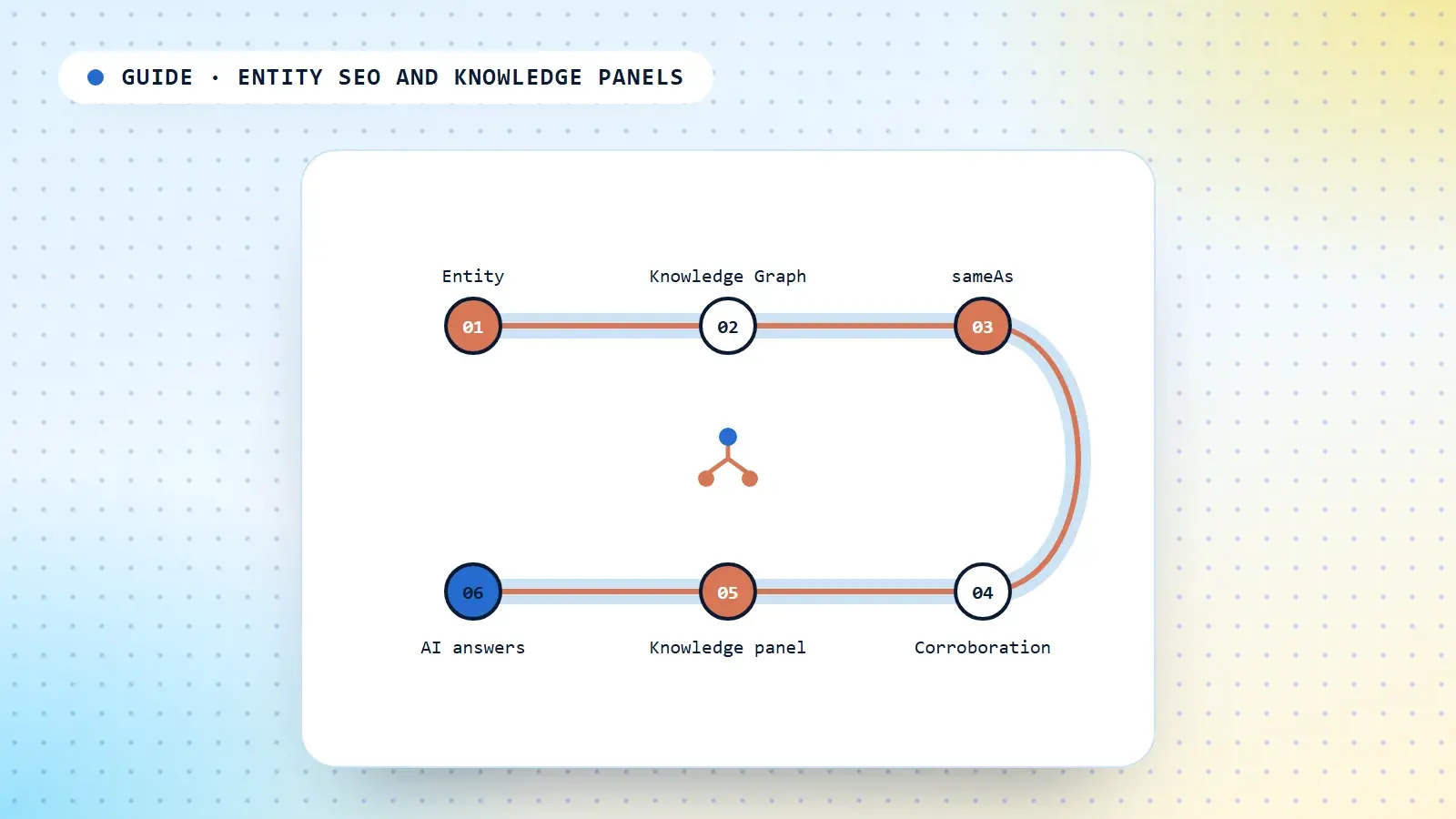
The practical model I work from is simple. An engine is more confident about a fact when several independent, credible sources state it, and less confident when they conflict or only the entity itself says it. That is not a secret ranking factor; it is the standard a careful researcher would apply.
- Facts stated on many sources
- Sources agree and link to each other
- Engine reconciles them to one entity
- Panels, brand results and AI answers
Define your entity on your own site
Your site is the one source you fully control, so it should be the clearest and most complete statement of who the entity is. Everything else you do points back to it.
The about page as the home of the entity
Choose one URL that represents the entity. For an organisation, this is usually the home page or the about page; for a person, a dedicated about or profile page. That page should state, in plain sentences near the top, what the entity is, what it does, where it is based, when it started and who is behind it. Write the definition you would want an engine or an AI assistant to repeat. "Example Dental is a family dental clinic in Indore, founded in [year] by Dr [Name]" is far more useful than three paragraphs about passion and excellence. The same discipline applies to every page you publish, and the guide to semantic content writing shows how to write that way.
For people: name, role, expertise, checkable credentials, employer and links to profiles elsewhere. I keep my about page and a separate profile page for this reason.
Organization and Person schema
Structured data turns those sentences into machine-readable statements. The common pattern is an Organization (or a more specific subtype such as LocalBusiness) on the home or about page, and a Person for each key individual, connected to each other:
- name, url and logo that match what appears everywhere else.
- A stable @id (for example, your home URL with #organization appended) so other markup on the site can refer to the same entity rather than redefining it.
- sameAs links to official profiles and reference entries that represent the same entity: your Wikidata item if one exists, LinkedIn, YouTube, X, Crunchbase, a company registry page.
- founder, employee or worksFor to connect the organisation and its people, and author on articles pointing to the Person.
- Contact details, address and founding date where they are true and visible on the page.
sameAs is the property that does the most entity work, because it says "this thing here is the same as that thing there". Only use it for profiles that genuinely represent the entity and that you control or that describe you accurately. Pointing sameAs at a directory listing that has the wrong phone number does not help. If you want to generate the markup rather than hand-write it, the schema markup generator covers the main types, and the semantic SEO guide explains what structured data does and does not do.
Consistent names, NAP and bios
Pick one canonical form of the entity name and use it everywhere: site header, footer, schema, profiles and press materials. Variations ("Example Dental", "Example Dental Care", "Example Dental Clinic Pvt Ltd") are normal in the wild, but your own properties should agree. For businesses with an address, keep name, address and phone (NAP) identical across the site and every listing. For people, write one short bio and one long bio, and reuse them on conference pages, guest posts and profiles so the same facts appear in the same words.
Corroboration across third-party profiles
A site describing itself is a claim. The same facts appearing on independent, credible sources is corroboration. This is where most entity work actually happens, and where most of the time goes.
| Source type | Examples | What it contributes | How to approach it |
|---|---|---|---|
| Open knowledge bases | Wikidata, Wikipedia | Structured facts and an identifier widely used as a reference | Only where the entity meets the project's notability rules; disclose any conflict of interest and cite independent sources |
| Official profiles | LinkedIn, YouTube, X, Instagram, GitHub, app stores | Accounts that the entity verifiably controls | Same name, logo, bio and website link on each; link back from your site |
| Business and registry data | Google Business Profile, Bing Places, company registries, Crunchbase | Legal name, address, founding date, category | Claim and complete; match NAP exactly to the site |
| Industry and professional | Professional bodies, trade associations, certification directories | Credentials and category membership that can be checked | Join where membership is genuine; keep listings current |
| Independent coverage | News, interviews, podcasts, conference speaker pages, reviews | Third-party confirmation of who you are and what you are known for | Earn it through real expertise; give hosts your standard bio and link |
Two principles govern this work. First, consistency beats volume. Ten profiles that agree are worth more than forty that each describe you slightly differently. Second, the profiles should form a connected web: your site links to them, they link to your site, and your schema names them in sameAs. That is what lets a system conclude they all describe one entity.
Wikidata deserves a specific caution. It is open to anyone, and that openness is often misused. Wikidata and Wikipedia both have notability expectations and conflict-of-interest guidance, and entries created purely for promotion are regularly deleted. If your entity is notable, with independent coverage that can be cited, an accurate and well-referenced item is valuable. If it is not, the better investment is earning the coverage first.
How knowledge panels appear and how to claim them
A knowledge panel is the box Google shows, usually beside the results on desktop and near the top on mobile, when it has enough confidence about an entity a query refers to. It can include a description, an image, key facts, social profiles and related entities. Google generates panels automatically from its own understanding; you cannot apply for one or buy one.
Panels tend to appear when a query clearly resolves to a single entity and Google holds enough corroborated facts to describe it. In my experience, the usual blockers are an ambiguous name, too few independent sources, and conflicting facts across sources. Fix those and a panel often follows, though no one can promise when or whether it will.
Claiming a panel through Google's official process
If a panel exists for you or your organisation, Google provides a way to get verified as its subject. The process, as Google documents it, works like this:
- Search for the entity and find the panel. Look for the option to claim it (usually worded along the lines of "Claim this knowledge panel").
- Follow the verification steps. Google asks you to sign in and confirm your identity, typically through an official account associated with the entity that it already recognises, such as a website verified in Search Console or an official social or YouTube account.
- Once verified, you can suggest changes to the panel's information through the feedback options Google provides, and some features let you choose things like the featured image.
Suggestions are reviewed, not applied automatically, and anyone, verified or not, can use the feedback link on a panel to report an error. If a fact is incorrect, fix it at the sources first (your site, your profiles, any reference entries), then submit the edit, so the correction has something to rest on. The exact wording and steps in Google's interface change from time to time, so follow its current help documentation rather than any screenshot in an old article.
Entity work for local businesses
For a local business, the most visible entity is usually the Google Business Profile, which powers the business panel in Search and the listing in Maps. This is managed through Business Profile itself, not through the knowledge panel claim process above, and it is where most local entity work starts.
The principles are the same, applied to a place:
- One location, one identity. Each physical location gets its own Business Profile, its own page on the site, and its own LocalBusiness markup with the exact address, phone and opening hours.
- NAP consistency everywhere. Directories, maps apps, review sites, social profiles and the site should agree. Old addresses after a move are one of the most common sources of confusion I see.
- Accurate categories. The primary category on the Business Profile and the schema type should describe what the business actually is.
- Local corroboration. Local news, chambers of commerce, associations and partner businesses that mention and link to the location confirm that it exists where it says it does.
- Separate the people. A doctor, lawyer or consultant who practises at the business can have their own Person identity, connected to the business, which matters when people search their name.
The local SEO guide covers Business Profiles, reviews and local rankings in detail, and the local SEO framework is the process I use for multi-location work. Entity clarity is the foundation underneath both.
Why entity clarity matters for AI answer engines
AI assistants and AI-generated search answers describe brands, people and products directly. When someone asks "who is a good SEO consultant for SaaS in India?" or "what does Example Dental charge for implants?", the answer is assembled from what the system knows about those entities and from pages it retrieves at the time.
Entity clarity affects this in three ways. First, accuracy: if sources disagree about what you do, the model may blend them, describe you vaguely, or confuse you with a similarly named entity. Second, attribution: a system that can confidently link a page to a known entity has a clearer basis for citing it. Third, inclusion: entities that are well described across credible sources are easier to retrieve and mention when a question touches their category.
I will not overstate this: no AI company publishes a rule that entities with knowledge panels get cited. But consistent facts on credible sources are what let any system describe you correctly. The AI SEO guide covers retrieval, citation and measuring AI visibility more broadly, and my note on AI search and fundamentals explains why this layer sits on top of ordinary SEO rather than replacing it.
AI answers describe you using what the web says about you. Entity SEO makes sure that information is clear and consistent everywhere.
A step-by-step entity SEO plan
This is the sequence I follow when an organisation or a person needs to be recognised properly. It works for a brand-new business and for an established one whose identity has become messy.
Audit what already exists
Search the entity's name, with and without qualifiers such as city or profession. Note whether a panel appears, which sources rank, what AI assistants say when asked who the entity is, and every fact that is wrong or inconsistent.
Write the canonical fact sheet
One document with the official name, short and long descriptions, founding date, founders or key people, address, phone, website, logo file, categories and the list of official profiles. Every later step copies from it.
Build the entity home on your site
Create or rewrite the about page so it states the facts plainly near the top. Add profile pages for key people, and make sure authorship on articles links to them.
Add connected structured data
Organization or LocalBusiness and Person markup with stable @id values, sameAs to genuine profiles, and author and publisher references on content. Validate it and check it matches the visible page.
Align official profiles
Update every profile you control to match the fact sheet: name, bio, logo, website link. Claim and complete Business Profile and other business listings, and fix or remove outdated ones.
Earn independent corroboration
Pursue coverage that genuinely fits: industry publications, interviews, speaking, associations, local press. Where the entity is notable, contribute an accurate, referenced Wikidata item following the project's rules. Link building that reinforces identity is covered in the link building guide.
Claim and maintain the panel
When a panel appears, verify through Google's process, then correct errors at their source before suggesting edits. Revisit the fact sheet whenever something changes, such as an address, a rebrand or a new leader.
Common mistakes
Treating schema as the whole job
Markup states your claims in a format machines read easily. It does not corroborate them. A site with perfect Organization markup and no independent mentions is still an entity that only vouches for itself.
Inconsistent names and details
Using a different name, logo or description on every platform, or leaving an old address on half the directories, gives the engine conflicting facts to reconcile. Consistency is boring and it is most of the work.
Creating promotional Wikipedia or Wikidata entries
Entries without independent sources, or written as marketing, tend to be challenged and removed, and the edit history stays visible. Earn the coverage, then let the reference entry reflect it.
Stuffing sameAs
Listing every directory, aggregator and unrelated profile in sameAs dilutes the signal. Use it for profiles that represent the same entity and that you would be happy for a stranger to treat as official.
Expecting a panel on a timetable
No one can guarantee a knowledge panel, and anyone who sells one is selling something they do not control. Measure the inputs you can influence and treat the panel as a possible outcome.
How to measure progress
Entity work changes slowly and does not show up as one clean metric, so I track a small set of signals over months rather than weeks:
- Brand search results. Search the entity name in a clean browser session at regular intervals and record whether a panel appears, whether its facts are right, and whether the top results are your own properties and accurate third-party sources.
- Knowledge Graph presence. Google's Knowledge Graph Search API can be queried for an entity name and returns matching entities with an identifier when they exist. A stable result for your entity is a useful sign it is recognised.
- Search Console brand queries. Impressions and clicks for branded and name-plus-topic queries, and whether the right page (usually the home or about page) receives them.
- AI answer checks. Ask several assistants the same fixed set of questions about the entity each month, such as who it is, what it does and where it is based, and log whether the answers are accurate and which sources they cite.
- Consistency score. A simple sheet of every profile and listing with a tick for whether each fact matches the fact sheet. The proportion that matches should rise towards complete.
Rankings for non-brand terms are not a direct measure of entity work, though in my experience a clearly defined entity makes the rest of a site's content easier to attribute and trust. For the topic side of that picture, go back to semantic SEO and topical authority. If you want to check terms used here, the SEO glossary defines them.
Frequently asked questions
What is entity SEO?
Entity SEO is the practice of making a specific person, organisation, product or place unambiguous to search engines and AI systems. It combines a clear self-description on your own site, structured data such as Organization and Person schema with sameAs links, consistent facts across official profiles, and corroboration from independent sources, so engines can recognise the entity and attribute content to it.
How is entity SEO different from semantic SEO?
Semantic SEO is broader: it covers how search engines understand the meaning of pages and topics, including entity salience, topic coverage and internal linking. Entity SEO focuses on identity, meaning who the people, brands and places behind the content are, and how to make that identity clear and consistent across your site and the wider web.
Can I pay to get a Google knowledge panel?
No. Google generates knowledge panels automatically when it has enough confidence about an entity, and there is no application or paid route. Anyone promising a panel is promising something they do not control. You can improve the conditions, such as consistent facts and independent coverage, and claim a panel once it exists.
How do I claim my knowledge panel?
Find the panel in Google Search and use the option to claim it. Google will ask you to verify that you represent the entity, typically by signing in to an official account it already associates with you, such as a Search Console property or an official social or YouTube account. After verification you can suggest edits, which Google reviews.
Do I need a Wikipedia page for entity SEO?
No. Wikipedia and Wikidata are useful references when an entity is genuinely notable, but many businesses and people are recognised without them. Creating promotional entries usually backfires because they get removed. Focus on a clear about page, schema, consistent official profiles and real independent coverage first.
How long does entity SEO take to show results?
It usually takes months rather than weeks, because search engines need to recrawl your site and the third-party sources that describe you, and reconcile any conflicting facts. Track brand results, Knowledge Graph presence, branded queries in Search Console and AI answer accuracy at regular intervals instead of expecting a single date when it works.