
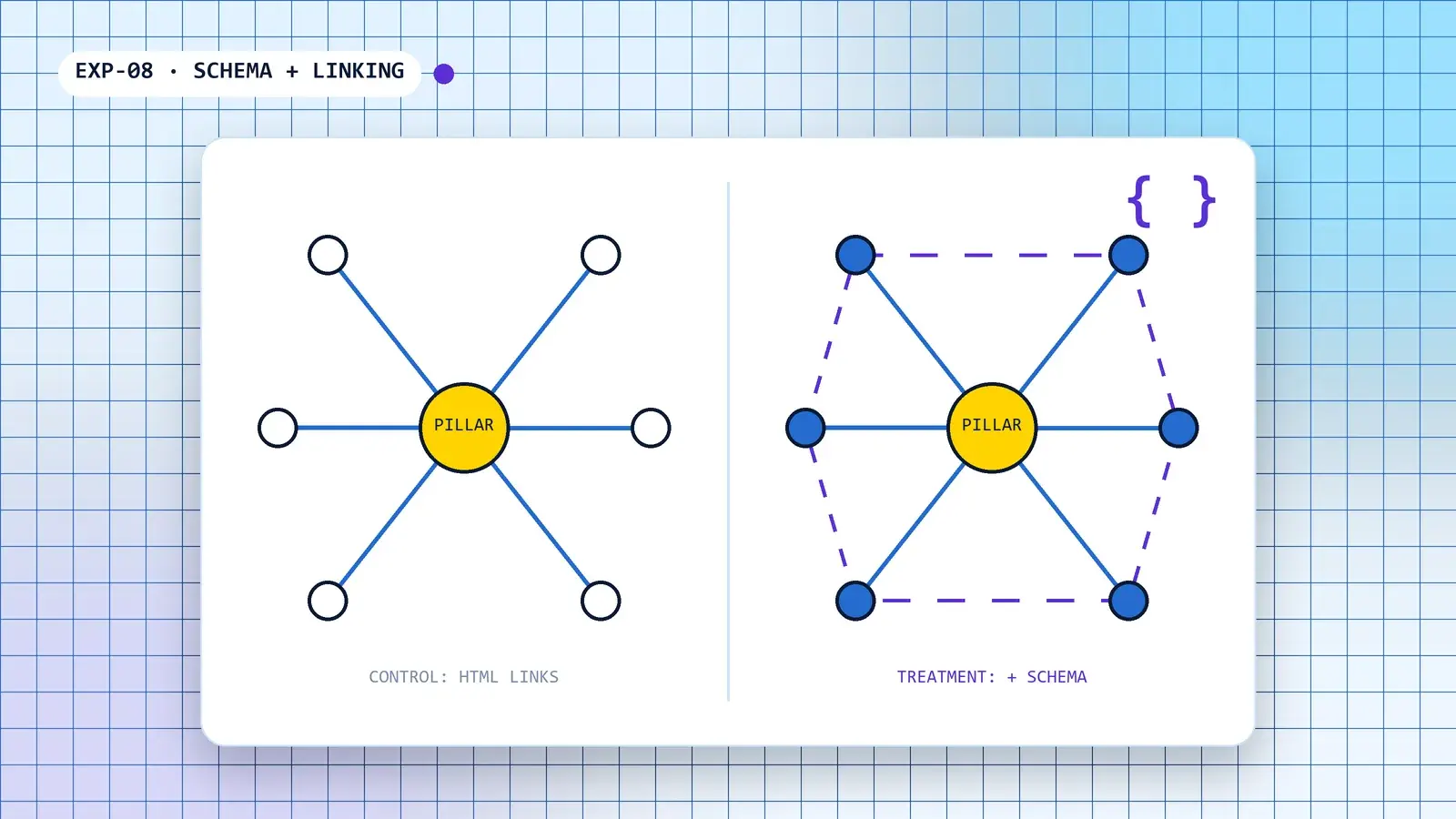
- Status
- Ongoing. Performance data is being collected; final findings will be published after the observation period.
- Type
- New website SEO experiment
- Primary area
- Schema-based internal linking
- Secondary areas
- Crawling, indexing, topical authority and organic search performance
1. Introduction
For a new website, establishing a strong content architecture from the beginning is an important part of SEO.
Unlike established websites, new websites do not have years of existing content, accumulated internal links, or extensive historical search performance data.
Every published article contributes to the website's developing structure.
This creates an opportunity to test an interesting SEO hypothesis: whether using Schema.org structured data to describe relationships between pillar pages, supporting articles, and related entities can provide additional value when building a website's internal linking architecture from scratch.
In this experiment, we are testing a schema-based content relationship system on a newly launched website.
The objective is to understand whether combining traditional HTML internal linking with structured content relationships can improve the organization and machine-readable representation of the website, and whether measurable differences emerge in crawling, indexing, and organic search performance.
Rather than assuming that schema markup improves rankings, we will monitor actual website data throughout the experiment.
2. Research hypothesis
The primary hypothesis is:
Implementing structured relationships between pillar pages and supporting articles from the beginning may provide additional machine-readable context about a new website's content architecture.
We are investigating whether this approach is associated with measurable differences in:
- URL discovery and Googlebot crawling.
- Indexing speed and indexing coverage.
- Organic impressions and clicks.
- Search visibility of pillar pages and supporting articles.
- Consistency of topic and entity relationships.
We also want to evaluate whether a centralized schema relationship system makes it easier to manage internal linking as the website grows.
3. Why test this on a new website?
A new website provides an opportunity to build its content architecture without having to work around years of existing internal linking decisions.
It also allows us to document the development of the website from its initial publishing stage.
There are several advantages:
- We can define the topic hierarchy before publishing large amounts of content.
- We can implement consistent entity identifiers from the beginning.
- We can establish relationships between pillar pages and supporting articles as content is published.
- We can monitor indexing from the website's early stages.
- We can track how organic visibility develops over time.
- We can evaluate whether the implementation is practical for scaling content production.
However, a new website also introduces limitations. Domain history, external backlinks, website trust, content quality, competition, and the time required for Google to discover a new domain can all influence results.
For this reason, the experiment will distinguish observed changes from effects that can actually be attributed to the implementation.
4. Experimental website and content architecture
The experiment will be conducted on a newly launched website.
The website will be developed around a clearly defined primary niche, with content organized into topic clusters.
Planned content architecture
The initial architecture will include:
| Content type | Planned quantity |
|---|---|
| Main pillar pages | 5 |
| Supporting articles per pillar | 10 |
| Total supporting articles | 50 |
| Total planned articles | 55 |
| Primary topic clusters | 5 |
These are the proposed experiment targets, not verified published-page counts.
Each pillar page will cover a broad subject, while supporting articles will target specific subtopics and search intents.
Example topic cluster
Pillar page: Technical SEO Complete Guide
Supporting articles:
- Crawl Budget Optimization.
- XML Sitemap Optimization.
- Robots.txt Best Practices.
- Canonical Tags Explained.
- Website Architecture for SEO.
- Internal Linking Best Practices.
- Website Indexing Guide.
- Technical SEO Audit Checklist.
- Core Web Vitals Guide.
- JavaScript SEO.
The same architecture will be used for the remaining topic clusters.
5. Experimental groups
To understand the incremental contribution of schema markup, the supporting articles will be divided into two groups.
| Parameter | Control group | Treatment group |
|---|---|---|
| Supporting articles | 25 | 25 |
| HTML internal linking | Yes | Yes |
| Additional schema relationships | No | Yes |
| Topic assignments | Yes | Yes |
| Canonical configuration | Same rules | Same rules |
| XML sitemap | Same configuration | Same configuration |
Both groups will receive a consistent HTML internal linking strategy.
The treatment group will additionally receive structured relationships using appropriate Schema.org properties.
The two groups should be matched by topic, publication timing, and content characteristics. Where practical, randomly assign articles within matched topic pairs.
This design allows us to examine whether schema provides an incremental effect beyond the normal internal linking implementation.
Because the website is new, we will also track the performance of the five pillar pages separately.
6. Schema implementation strategy
The treatment group will use structured data to describe the actual relationships between webpages, topics, and entities.
The implementation will use:
WebPageBlogPostingaboutmentionsrelatedLinkisPartOf, where appropriatehasPart, where appropriate
Example: pillar page
{
  "@context": "https://schema.org",
  "@type": "WebPage",
  "@id": "https://example.com/technical-seo/#webpage",
  "url": "https://example.com/technical-seo/",
  "name": "Technical SEO Complete Guide",
  "hasPart": [
    {
      "@id": "https://example.com/crawl-budget/#webpage"
    },
    {
      "@id": "https://example.com/xml-sitemap/#webpage"
    }
  ]
}
Use hasPart only if the pillar page genuinely represents a larger resource composed of those supporting resources.
For independent related articles, do not force a part-to-whole relationship.
Example: supporting article
{
  "@context": "https://schema.org",
  "@type": "BlogPosting",
  "@id": "https://example.com/crawl-budget/#article",
  "headline": "Crawl Budget Optimization Guide",
  "mainEntityOfPage": {
    "@id": "https://example.com/crawl-budget/#webpage"
  },
  "about": {
    "@type": "Thing",
    "@id": "https://example.com/topics/technical-seo/#topic",
    "name": "Technical SEO"
  }
}
The treatment group will receive the additional structured data, while the control group will retain the standard schema implementation.
The control group should not be deprived of essential structured data or required website information. The experimental variable is the additional content relationship markup, not the removal of basic schema.
7. Internal linking strategy
Both groups will follow the same traditional internal linking rules.
Every supporting article should have a relevant contextual connection to its pillar page.
Pillar pages should link to relevant supporting articles.
Supporting articles may link to other articles when the relationship helps the reader.
Example
Article A: Crawl Budget Optimization
Potential internal links:
- Technical SEO Complete Guide.
- XML Sitemap Optimization.
- Robots.txt Best Practices.
- Website Indexing Guide.
Article B: XML Sitemap Optimization
Potential internal links:
- Technical SEO Complete Guide.
- Crawl Budget Optimization.
- Website Indexing Guide.
The HTML links will be implemented consistently across both groups.
This is important because we do not want the treatment group to receive more internal links than the control group.
Otherwise, it would become difficult to separate the contribution of schema from the contribution of traditional internal linking.
8. New website launch and experiment timeline
The experiment will follow a 16-week framework to accommodate the initial discovery and development period of a new website.
| Phase | Timeline | Activities |
|---|---|---|
| Phase 1 | Weeks 1–2 | Website launch and technical setup |
| Phase 2 | Weeks 3–4 | Initial content publishing and baseline collection |
| Phase 3 | Weeks 5–6 | Schema relationship implementation |
| Phase 4 | Weeks 7–10 | Crawling and indexing monitoring |
| Phase 5 | Weeks 11–14 | Organic performance monitoring |
| Phase 6 | Weeks 15–16 | Preliminary analysis |
The timeline is a research plan, not a guarantee that Google will discover or index all pages within these periods.
If the website has not received sufficient crawling or search impressions by the end of the observation window, the experiment will continue.
9. Baseline and data collection
Because this is a new website, the baseline will be established as the pages are published and become eligible for measurement.
We will record the following information:
| Metric | Initial measurement |
|---|---|
| Published articles | Actual count |
| Submitted sitemap URLs | Actual count |
| Indexed URLs | Actual count |
| Organic clicks | Actual count |
| Organic impressions | Actual count |
| Average position | Actual count |
| Googlebot requests | Verified server log count |
| Internal links | Crawler report |
| Schema errors | Validation report |
Unlike an established website, there may initially be no meaningful organic traffic or indexing history.
Zero impressions or clicks during the first few weeks should not be interpreted as an experiment failure.
10. Performance metrics being monitored
A. URL discovery and crawling
We will monitor:
- Time between publishing and first verified Googlebot request.
- Number of URLs crawled.
- Crawl frequency.
- Crawl requests by page group.
- Changes in crawling patterns.
Server logs will be used to verify Googlebot activity.
B. Indexing
We will record:
- Number of submitted URLs.
- Number of discovered URLs.
- Number of indexed URLs.
- Number of non-indexed URLs.
- Time between publication and first observed indexing.
The indexing rate will be calculated as:
Indexing rate = (Indexed eligible URLs ÷ Total eligible published URLs) × 100
For example, if 40 eligible published articles exist and 24 are indexed:
(24 ÷ 40) × 100 = 60%
This is a measurement example, not an actual experiment result.
C. Organic search performance
Using Google Search Console, we will track:
- Total clicks.
- Total impressions.
- Average position.
- Click-through rate.
- Number of pages receiving impressions.
- Search query distribution.
D. Website architecture
We will also track:
- Incoming internal links per page.
- Orphan pages.
- Broken internal links.
- Pillar-to-supporting article connections.
- Schema relationship validation.
- Duplicate entity identifiers.
11. Experiment tracking dashboard
The following table will be maintained throughout the experiment.
| Metric | Control group | Treatment group |
|---|---|---|
| Published articles | 25 planned | 25 planned |
| Indexed articles | Pending | Pending |
| Organic clicks | Pending | Pending |
| Organic impressions | Pending | Pending |
| Average position | Pending | Pending |
| Googlebot requests | Pending | Pending |
| Indexing rate | Pending | Pending |
| Broken internal links | Pending | Pending |
| Schema errors | Baseline | Pending |
The dashboard will be updated weekly.
All numbers will be collected from the actual website and reporting platforms.
12. Measuring the incremental impact
The primary comparison will be between treatment and control articles.
We will use a Difference-in-Differences approach when sufficient baseline and follow-up observations are available.
DiD = (Tafter − Tbefore) − (Cafter − Cbefore)
This helps distinguish differences in the treatment group's performance from broader changes affecting the website.
For a new website, however, early observations may contain many zero values and very little search data.
Therefore, we will also examine:
- Time to first crawl.
- Time to first index.
- Proportion of eligible URLs indexed.
- Time to first organic impression.
- Organic impressions per indexed page.
- Organic clicks per indexed page.
For stronger statistical evidence, we will use matched page-level comparisons and account for publication dates, topic differences, and unequal traffic volumes.
13. Additional experiment: testing schema with improved internal linking
Once the initial experiment provides sufficient data, we plan to conduct a second comparison.
This will use three groups:
| Group | HTML internal links | Additional schema relationships |
|---|---|---|
| Group A | Standard | No |
| Group B | Improved | No |
| Group C | Improved | Yes |
This will help determine whether the combined implementation offers additional value beyond conventional internal linking.
The comparison between Groups B and C will be particularly important.
14. Challenges and limitations
Testing SEO on a new website introduces several challenges.
- New domain discovery: Search engines may take time to discover and crawl a new website.
- Limited historical data: There may not be sufficient baseline data for statistically reliable comparisons.
- Low initial impressions: New pages may take time to receive search visibility.
- External influences: Algorithm updates, competitors, backlinks, and content quality can influence outcomes.
- Indexing variability: Publishing a URL or adding schema does not guarantee indexing.
- Sample size: Fifty supporting articles may be insufficient to detect small effects, especially when divided into experimental groups.
We will document these limitations rather than interpreting every change as a direct consequence of schema implementation.
15. Current research status and next steps
The experiment is being structured around a new website, with a focus on implementing a consistent content architecture from the beginning.
The next activities are:
- Finalize the website's five primary topic clusters.
- Establish the pillar and supporting article structure.
- Publish the initial content.
- Implement consistent HTML internal links.
- Apply additional schema relationships to the treatment group.
- Validate the JSON-LD implementation.
- Monitor Googlebot crawling and indexing.
- Record weekly Google Search Console performance.
- Compare control and treatment groups.
- Publish the final findings after sufficient data collection.
Conclusion
This ongoing experiment explores whether Schema.org relationships can add measurable value to the internal linking architecture of a newly launched website.
By starting with a new domain, we have an opportunity to establish content relationships from the beginning and observe how the website develops over time.
The experiment separates actual HTML internal links from structured data relationships, allowing us to evaluate the incremental contribution of schema more carefully.
The final objective is to determine whether a structured, entity-based content relationship system offers measurable advantages in website organization, crawling, indexing, or organic search performance.
Related reading
The background to this test is covered in the internal linking guide, which explains why HTML links remain the primary signal, and the entity SEO guide, which covers how structured data and consistent identifiers describe entities. The method for planning links across a site is the internal linking framework.